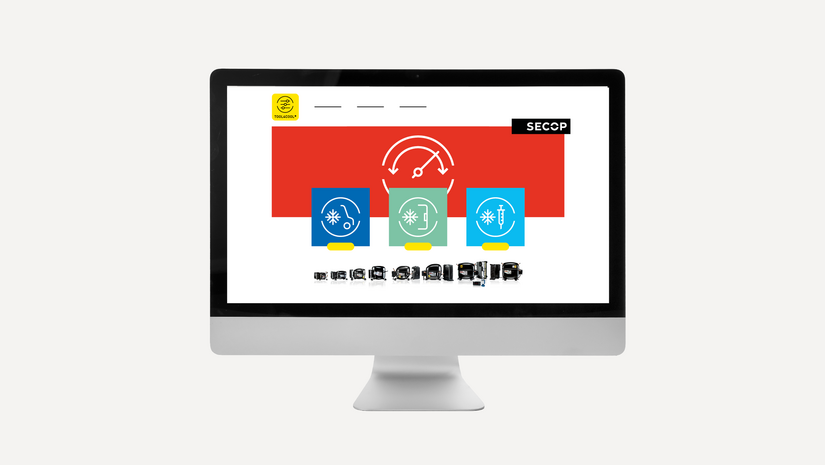
Unidad de Velocidad Variable.

Los motores de compresores de velocidad variable están controlados electrónicamente. El funcionamiento a plena carga es extremadamente raro en la mayoría de las aplicaciones de refrigeración, limitado solo a unos pocos días al año.

Esta tecnología única permite que la capacidad se adapte automáticamente a la demanda real. El compresor funciona a baja velocidad la mayor parte del tiempo, lo que minimiza el consumo de energía.

Además, la eficiencia del sistema se mejora considerablemente gracias a la reducción de pérdidas cuando se transfiere menos calor a través del evaporador y el condensador. En conjunto, se pueden obtener ahorros de energía significativos.

Compresores de Velocidad Variable Secop.

Desde 1998, cuando se desarrolló el primer compresor de velocidad variable TLV, Secop ha desarrollado y optimizado continuamente sus compresores de velocidad variable y la electrónica de control para aplicaciones comerciales y soluciones con baterías de corriente continua (DC).

Hoy ofrecemos una gama completa de compresores con variador de velocidad, desde la pequeña serie BD para refrigeración móvil hasta la serie S para grandes soluciones en el comercio minorista de alimentos, incluyendo una línea con refrigerantes hidrocarburos ecológicos.

Secop entiende que operar a plena capacidad es extremadamente raro en la mayoría de las aplicaciones de refrigeración; por eso hemos incorporado dispositivos de control de velocidad variable en las series BD, DLV, NLV y SLV/E, que adaptan automáticamente la velocidad a las necesidades operativas.

Esto significa que los compresores generalmente funcionan a baja velocidad, minimizando el consumo de energía y mejorando considerablemente la eficiencia.

Los compresores de velocidad variable de Secop están diseñados para sistemas de refrigeración que usan los refrigerantes designados R600a (isobutano) y R290 (propano).

Software para variador de velocidad.

El control y monitoreo óptimo de un sistema de refrigeración es esencial. La herramienta de software única de Secop, Tool4Cool®, te permite configurar con precisión los compresores de velocidad variable (inversor) Cool Capacity Drive (CCD) de Secop para tus sistemas de refrigeración.


Artículo Detallado y Tool4Cool

Compresores de Velocidad Variable Alimentados por Corriente Alterna (AC) y Corriente Continua (DC)

  • Variable-Speed Drive Compressors

    Variable-Speed Drive Compressors

    | Literature | Quick References

    Download (5.48 MB)
  • DC-Powered Compressors for Mobile Cooling

    DC-Powered Compressors for Mobile Cooling

    | Literature | Quick References

    Download (2.19 MB)

Common Questions About Variable-Speed Drive

What does “Variable-Speed Drive” (VSD) mean?

The Variable-Speed Drive technology refers to Secop compressors with electronically controlled motor speed that automatically adjust their capacity to match the actual cooling demand.

Why are VSD compressors more energy-efficient than fixed-speed compressors?

Because they typically run at lower speeds (“low speed”), create less extreme operation pressures which reduces energy consumption and minimizes system losses. Energy savings of approximately 20% to 40% are achievable.

Since when and in which product lines does Secop use VSD technology?

Secop developed the first TLV Variable-Speed compressor in 1998 and today offers a full range of VSD compressors – e.g., the BD series, NLV, and SLV/SLVE – covering applications from small mobile cooling to large food retail systems.

For which applications and markets are VSD compressors suitable?

The technology is used in mobile cooling (e.g., DC battery-powered units), light commercial refrigeration (LBP/MBP), food retail applications, and large stationary systems.

Which technical features of the VSD controllers are particularly noteworthy?

The inverter controllers (e.g., °CCD) allow operation with the perfect cooling capacity of the compressor by adjusting the motor speed. They provide a speed ratio of approximately 1:4, and thus high efficiency, integrated protection features, modular architecture, and more.

What role does the Tool4Cool® software play in combination with VSD compressors?

Tool4Cool® enables precise configuration, monitoring, and optimization of VSD compressors – parameters can be adjusted, data can be logged, and systems can be monitored remotely.

Which environmental or sustainability aspects does Secop’s VSD technology support?

By reducing energy consumption, improving overall system efficiency, and lowering waste heat and noise emissions, VSD technology contributes to sustainable refrigeration.

What operational advantages result from using VSD compressors?

Key benefits include lower power consumption, less stressful short-time operation, more stable cabinet temperatures, the possibility of smaller displacement compressors, and reduced noise levels.

What challenges or requirements exist when designing systems with VSD compressors?

System selection and design differ from fixed-speed compressors: for example, selection based on maximum capacity, optimization for part-load operation, adjustments to appliance design (evaporator/condenser sizing), and the need for suitable control systems.

We use cookies to personalize content and ads, to provide social media features and to analyze our traffic. We also share information about your use of our site with our social media, advertising and analytics partners. Click "Manage preferences" if you would like to read more about our cookies and adjust your preferences. By clicking "Accept all", you agree to the use of all cookies as described in our Privacy Policy. Política de privacidad