Secop Variable-Speed Compressors for Commercial Refrigeration
Benefits and How to Choose a CF, MP, or XT Controller
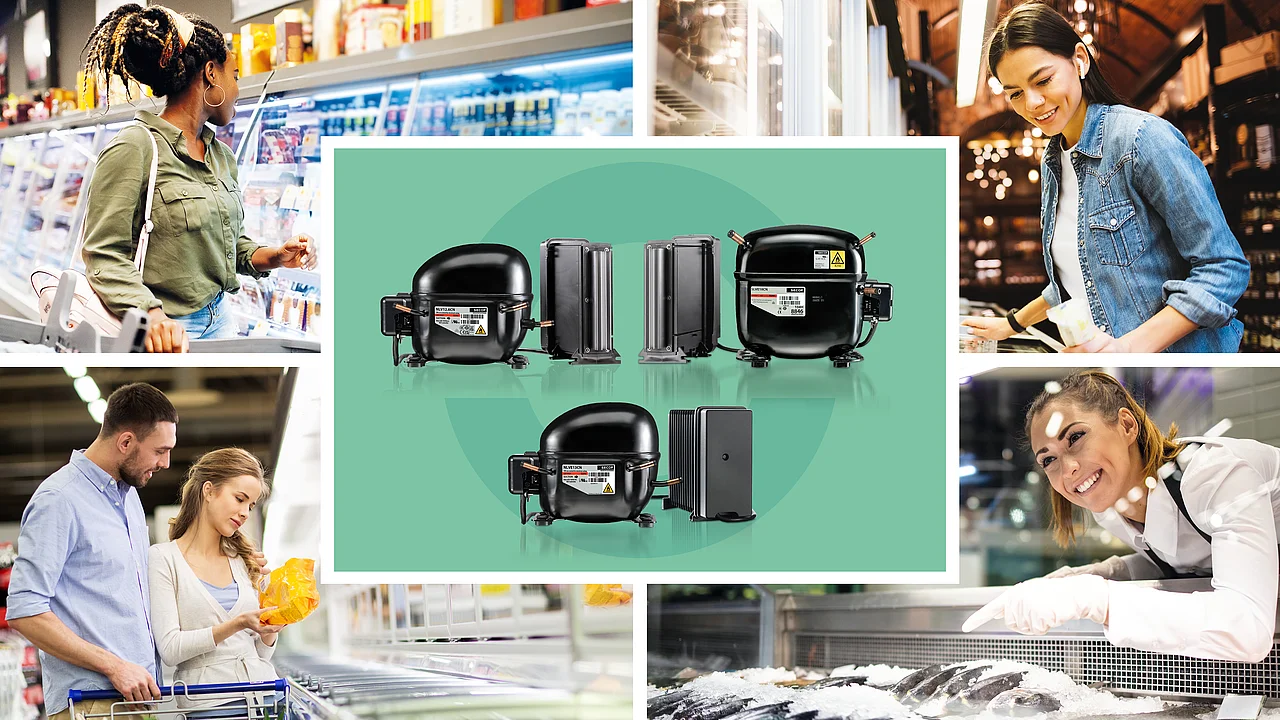
A variable-speed compressor for commercial refrigeration is a hermetic reciprocating compressor whose motor speed is set electronically, so cooling capacity follows the cabinet's actual load instead of cycling fully on and off. Secop's variable-speed drive (VSD) platforms pair with one of three electronic controllers: CF (Core Functions), MP (Multipurpose), or XT (Extended). The right choice depends on how much the cabinet needs the controller to manage beyond the compressor itself.
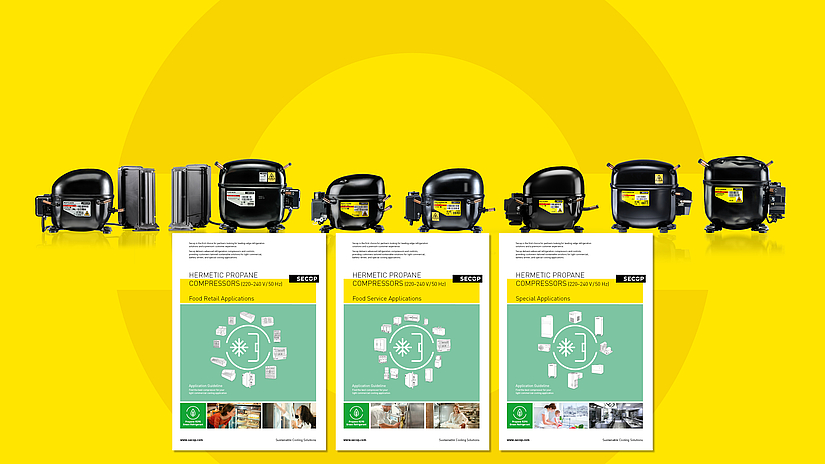
Secop Quick Reference brochures make it easier to find the most suitable compressor for your application. This brochure contains technical data, performance data, dimensional sketches, and wiring diagrams.
Is an Inverter Compressor the Same as a Variable-Speed Compressor?
Yes. "Inverter compressor" and "variable-speed compressor" describe the same technology: a compressor whose motor runs at a speed set by an electronic drive, rather than at one fixed speed that simply switches on and off. Secop uses "variable-speed drive" (VSD) as its house term for the technology. Its controllers for these compressors come in three versions, CF, MP, and XT; the MP and XT leaflets name them °CCD (Cool Capacity Drive) controllers.
The two labels come from different parts of the industry. "Inverter" describes the drive electronics that convert the incoming supply into a variable-frequency signal for the motor. "Variable-speed" describes the result at the compressor shaft: a motor speed that moves across a range instead of sitting at one point. In a Secop NLV, NLVE, or SLVE compressor, both terms point to the same hardware: a hermetic reciprocating compressor whose rotational speed is set by the controller.
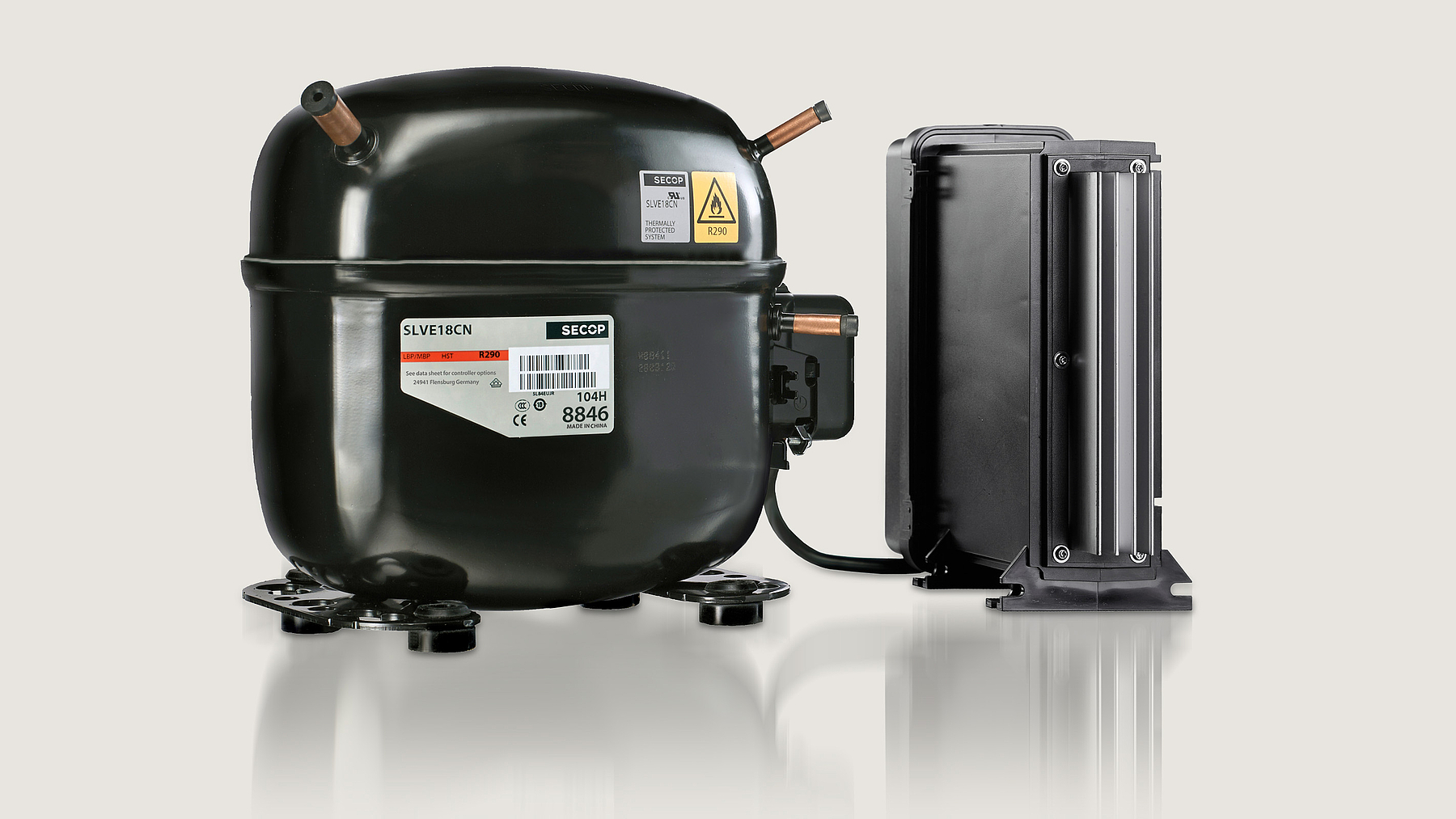
Secop NLV/E and SLVE Compressors
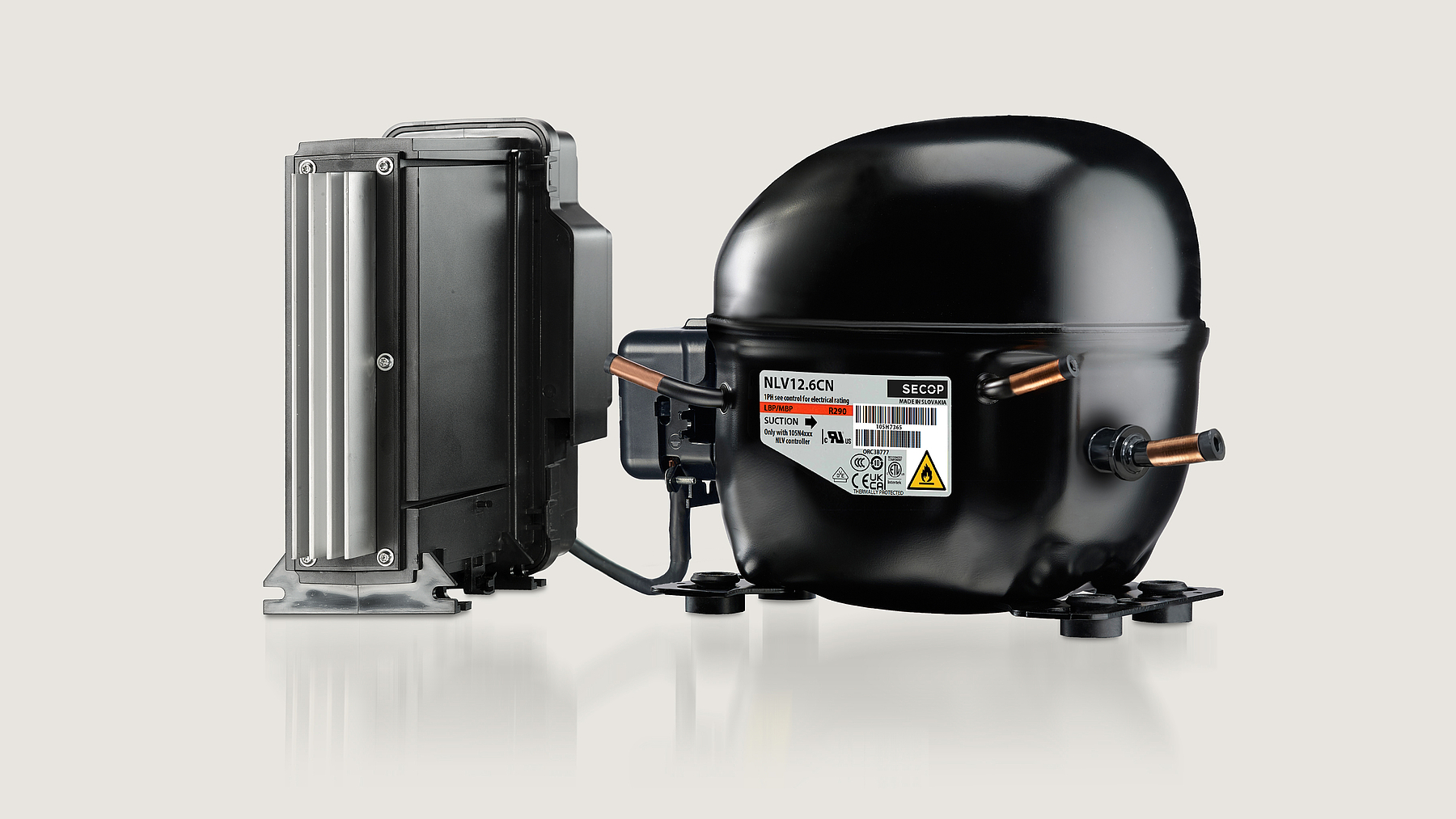
NLV Compressor with MP Controller
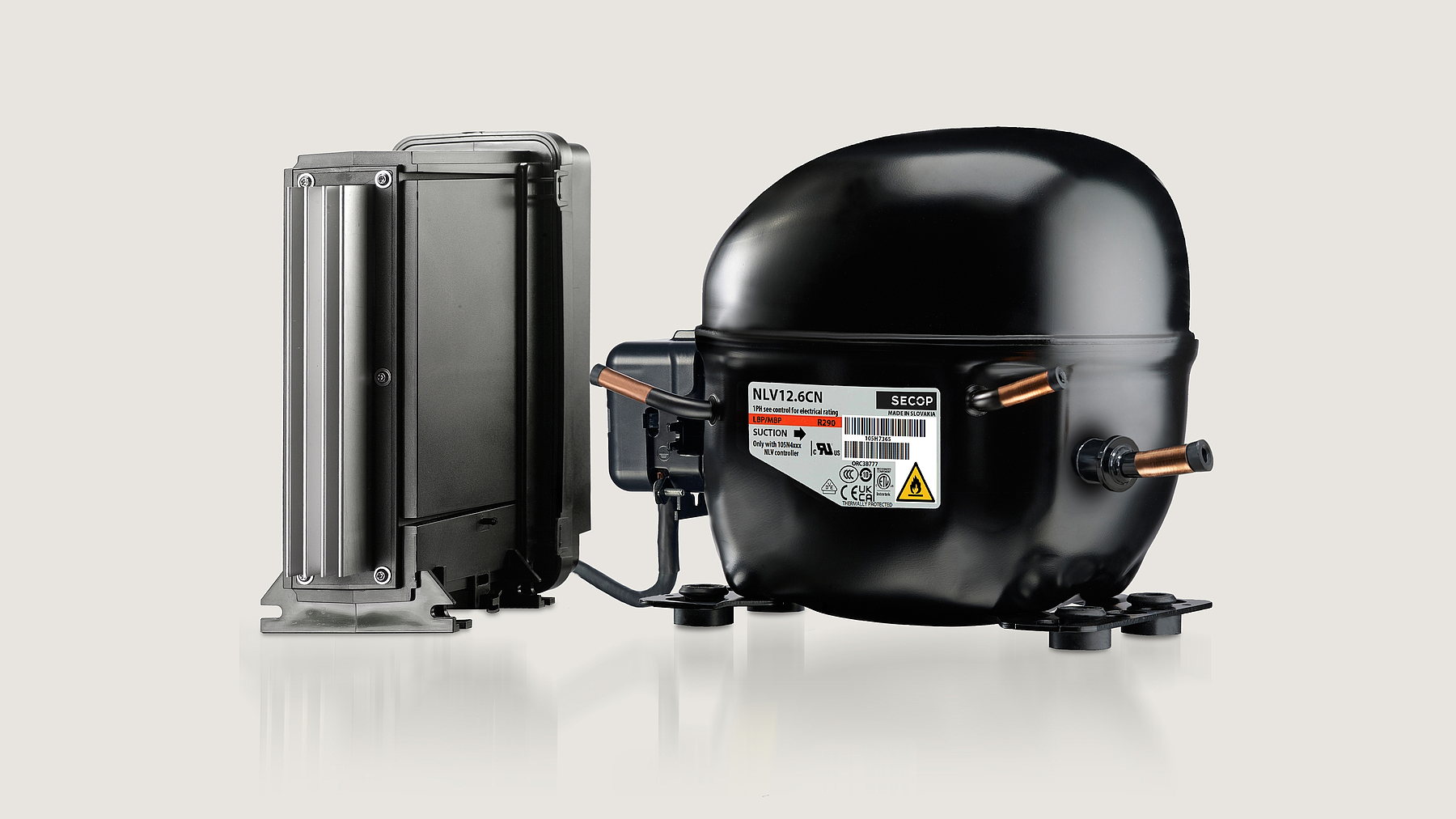
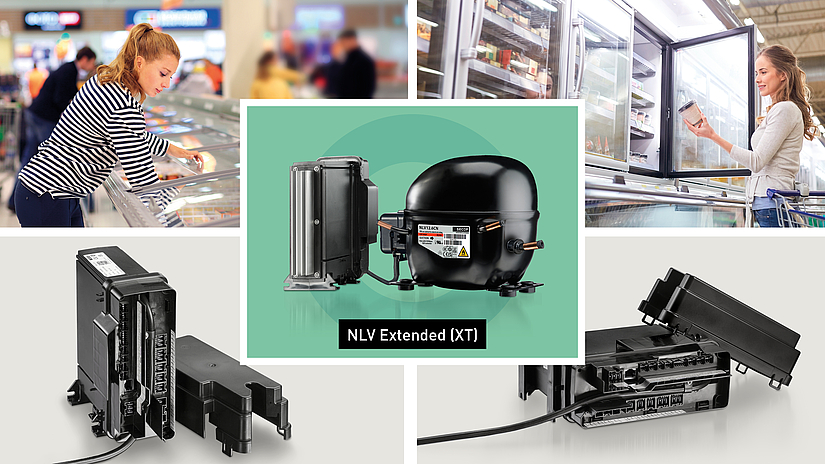
NLV Compressor with XT Controller
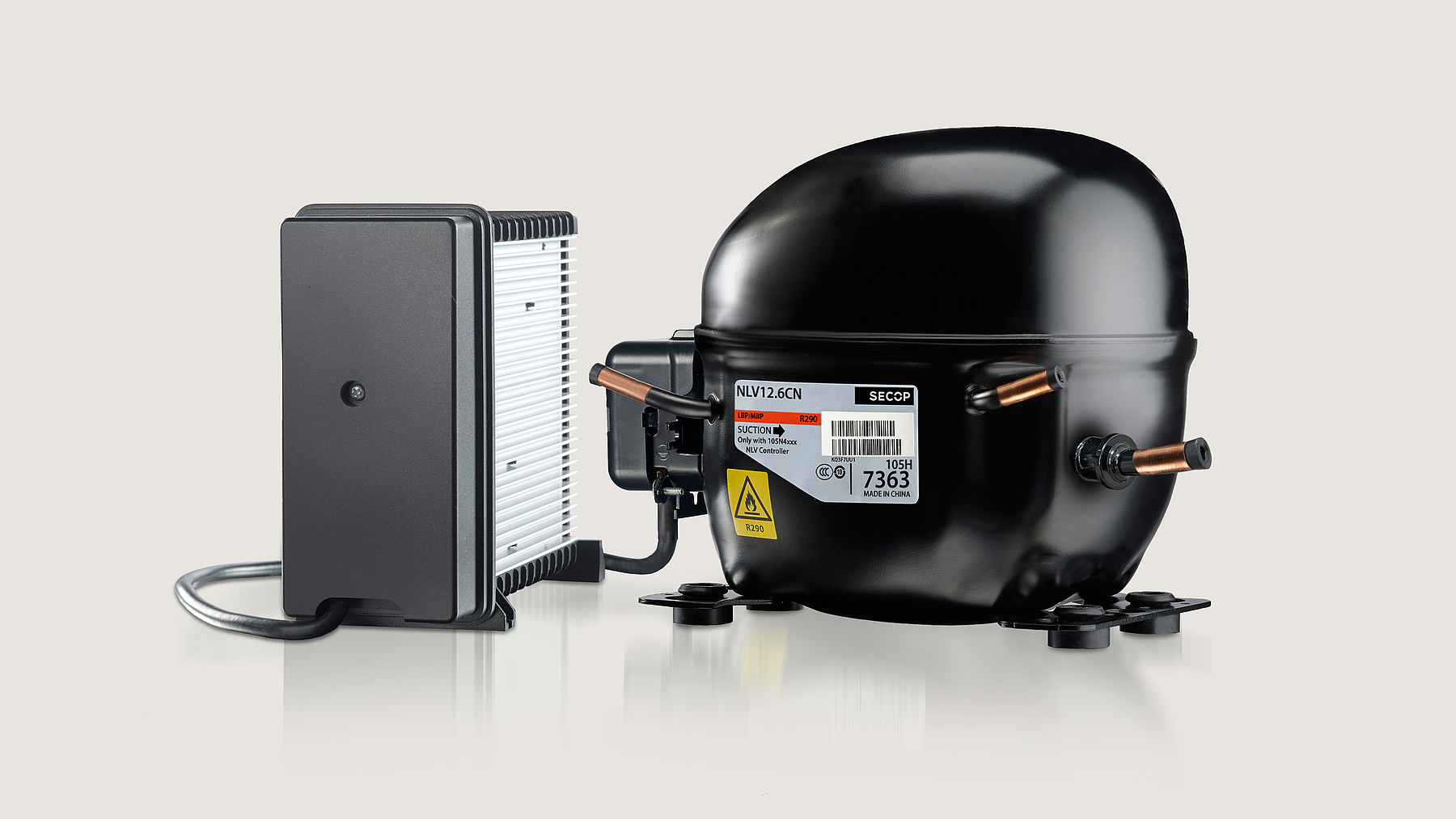
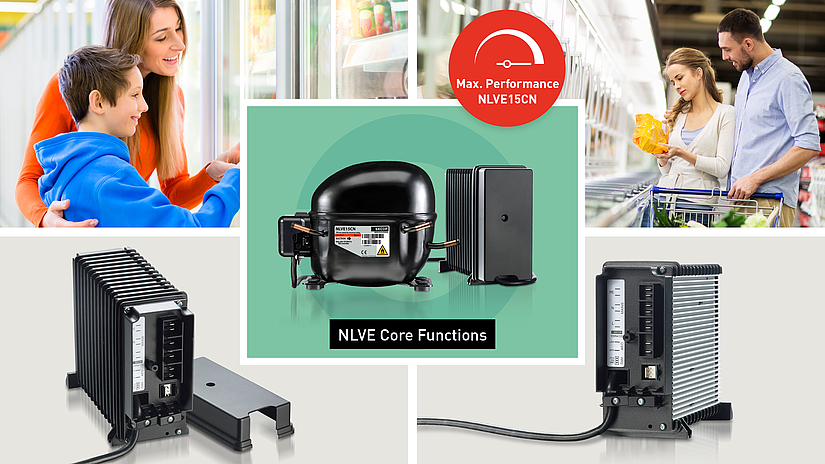
NLV Compressor with CF Controller
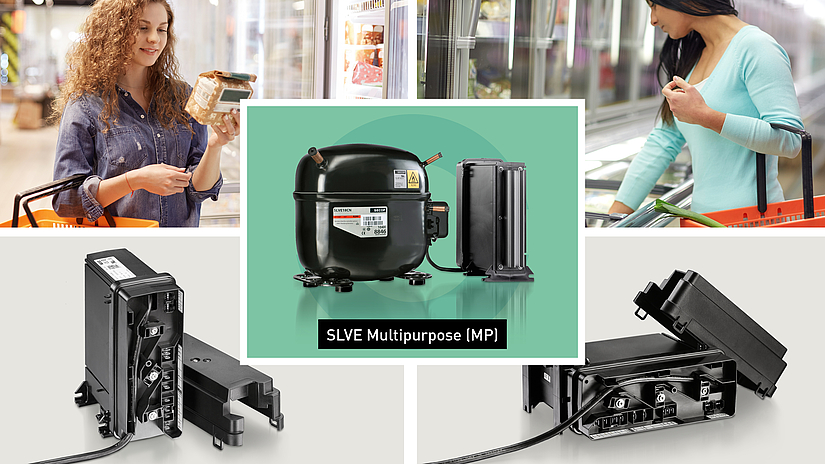
SLVE Compressor with MP Controller
What Are the Benefits of a Variable-Speed Compressor Compared to Fixed-Speed (On/Off)?
A fixed-speed compressor has one operating point: full capacity, running or stopped. It is sized for the worst case, the hottest day, the most door openings, the fullest load, and for the rest of the time it cycles on and off to avoid overcooling. Full-load operation is extremely rare in most cooling applications, restricted to a few days a year, which is exactly the condition a fixed-speed compressor is built around.
A variable-speed compressor addresses that mismatch directly. The benefits are:
Lower energy consumption, by design. At partial load, a variable-speed compressor runs with a higher evaporating temperature and a lower condensing temperature than a fixed-speed compressor cycling at full capacity, which raises the efficiency of the refrigeration cycle itself. Secop states energy savings of approximately 20% to 40% are achievable with variable-speed drive, "up to 40%, depending on the system design," compared to a fixed-speed compressor in on/off operation. For the SLVE18CN specifically, Secop's news on the fully optimized system states up to 50% savings.
A documented field result. In Secop's public case story with AHT Cooling Systems, a variable-speed SLV compressor used approximately 30% less energy than an identical cabinet running a fixed-speed, on/off compressor, with the same refrigerant. Switching that cabinet's refrigerant to R290 added a further 9% efficiency gain on top. Further down on this page, a section discusses two Secop application studies that show the same pattern in food service and food retail cabinets.
Steadier cabinet temperature. Variable speed holds a tighter temperature through every door opening, protecting the product on the shelf while lowering the energy it takes, as Secop describes it for food retail cabinets.
Fewer, gentler starts. Running continuously at a matched speed instead of stopping and restarting reduces the stress of frequent short-cycling.
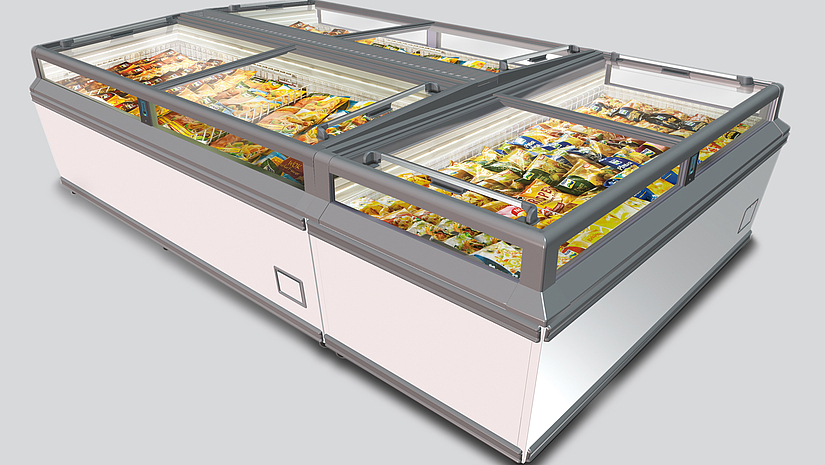
Lower noise at low speed. Secop's variable-speed compressors cut noise by up to 5 dB(A) when running at low speed, relevant for open-front merchandisers on a retail floor.
A smaller compressor, more cabinet volume. Because the compressor can run above its nominal point when load spikes, OEMs gain the option of a smaller-displacement, smaller-footprint compressor for a given peak duty, which leaves more net volume inside the cabinet for product.
Built for rough grids and climates. Secop releases its variable-speed compressors "for rough applications, unstable power supply, and tropical regions," with bi-frequency operation at 115-127 V, 100-240 V, and 220-240 V, 50/60 Hz, so the same compressor type serves different markets.
High efficiency at the drive itself. Secop's inverter electronics reach efficiency as high as 98%, so little of the energy fed to the drive is lost before it reaches the motor.
A confident start, every time. All of Secop's variable-speed controllers support High Starting Torque (HST), so the compressor starts directly against a high differential pressure; no pressure equalization is required before start.
Are There Downsides to Variable-Speed Compressors?
A variable-speed compressor and its electronic controller cost more upfront than a fixed-speed compressor wired to a simple thermostat relay. The OEM also takes on more integration work: wiring the controller into the cabinet's defrost, fan, and sensor circuits, and configuring it with Secop's Tool4Cool® software rather than simply switching it on.
Secop's own guidance to OEMs states the payback case directly: "the initial investment might be slightly higher when using a compressor with an inverter, but the operating costs and therefore the total cost of ownership will be significantly lower. The return on investment is extremely quick especially in high priced energy markets." Full-load operation is rare, so a fixed-speed compressor spends most of its life cycling on and off at full capacity rather than running at the lower average demand a variable-speed compressor can match; the 20% to 40% savings range comes from exactly that gap, and it accrues throughout the cabinet's normal, partial-load operating life. Smaller displacement options can also offset part of the component cost.
Secop's Variable-Speed Compressor Portfolio for Commercial Refrigeration
Secop's variable-speed controllers set compressor speed through one of four methods, and this is the bridge from the benefits above to choosing the right electronics.
Adaptive Energy Optimization (AEO). With a thermostat or low-voltage on/off signal, the controller runs its built-in AEO algorithm, which looks for the lowest speed that still keeps the cabinet within its set range. If the cabinet reaches cut-out within the defined run time, the next cycle starts slightly lower; if not, speed rises slowly. COP is highest at low speed, so AEO is Secop's way of keeping the compressor there as much as the load allows.
Frequency signal. A variable square-wave signal spans the compressor's minimum to maximum speed, giving the cabinet's own control system direct command of the speed setpoint.
Serial communication. The controller accepts a speed command over a serial link, and Modbus is available on MP for remote monitoring of the compressor's operating parameters.
0-5 V analog signal and closed-loop control. XT adds a 0-5 V analog input and closed-loop control on top of the AEO, frequency, and serial communication modes shared by CF and MP.
Integrated PI control. Where the controller reads cabinet temperature directly, a built-in PI control compares it against a reference setpoint and adjusts capacity to close the gap.
Secop configures and monitors all these modes through Tool4Cool®, its PC-based software tool, which sets the speed range, defrost behavior, and protection thresholds for the specific cabinet. Which of these control modes a cabinet needs, and how much case-level control (fans, defrost, sensors) has to run through the same controller, is what separates Secop's three controller families.
Secop's R290 portfolio for commercial refrigeration spans up to 2,500 W across both fixed-speed and variable-speed compressors; the variable-speed tier splits into CF, MP, and XT.
CF Core Functions
MP Multipurpose
XT Extended
Positioning
The professional standard: essential controls for full operational coverage
The global range: a wider set of features and high adaptability to custom requirements
The top of the range: specialized applications and industries with specific design and control requirements
Compatible compressors
NLV8.0CN
NLV10CN,
NLV12.6CN
NLVE13CN
NLVE15CN (new, forthcoming)
NLV8.0CN
NLV10CN
NLV12.6CN
NLV15CN
SLVE18CN
NLV8.0CN
NLV10CN
NLV12.6CN
Controller code numbers
105N4120 (220-240 V, CCC)
105N4100 (115-127 V, US GFCI-conformity, UL Recognized)
198-264 V (105N4120, 1054110); 115-127 V (105N4100)
180-270 V (standard); 90-270 V (multi-voltage)
90-270 V
Evaporating range, continuous
-40°C to 0°C (-40°F to 32°F); no HBP rating point published
-40°C to +7.2°C (-40°F to 45°F); SLVE18CN: -45°C to +10°C (-49°F to 50°F)
-40°C to +7.2°C (-40°F to 45°F)
Speed control
AEO, frequency signal, serial, automatic input detection
AEO, frequency signal, serial, automatic input detection, Modbus
AEO, frequency signal, serial, plus closed-loop control and 0-5 V analog input
Case control
One extra input for the temperature controller's defrost relay; two-speed defrost
Two additional relays, two-speed defrost, remote software/parameter upgrade
Eight relays, four temperature sensors, four digital/analog I/O; options: IoT connectivity, multi-compressor operation, pressure switch
CF and XT both run the NLV8.0CN, NLV10CN, and NLV12.6CN compressors, so the choice between them on that family comes down to how much case control the cabinet needs, not compressor compatibility. Today the SLVE18CN is offered with MP, through the dedicated 105N4932 controller. For cabinets running up to +7.2°C (45°F), MP or XT is the correct choice.
Efficiency across the speed range. For NLV12.6CN paired with XT, ASHRAE MBP capacity rises from 766 W at 2,000 rpm to 1,772 W at 4,500 rpm, with COP moving from 2.18 to 2.12 W/W; ASHRAE LBP capacity rises from 393 W to 916 W, with COP moving from 1.76 to 1.80 W/W. Capacity follows demand without a meaningful COP penalty across most of the speed range.
Choose CF if the cabinet needs reliable variable-speed control and basic defrost handling, and the electronics do not need to manage fans, additional sensors, or remote monitoring. CF is the entry point into Secop's variable-speed range.
Choose MP if the cabinet needs the controller to also run the condenser fan and handle more complex defrost sequencing, or needs Modbus-based remote monitoring and alarms, and the installation calls for a fire-proof, multi-voltage enclosure usable across global markets, including the SLVE18CN platform.
Choose XT if the cabinet has to control its own fans, sensors, and heaters as one integrated thermal system. With eight relays, four temperature sensors, and four digital/analog I/O points, plus options for IoT connectivity and multi-compressor operation, XT is built for specialized and critical installations, including medical cabinets, where the controller manages the compressor, fans, sensors, and heaters together.
Can an Existing System Be Retrofitted with a Variable-Speed Compressor?
There is no generic kit to retrofit a fixed-speed compressor with a variable-speed one in the field. What Secop has validated, across several cabinet redesigns, is that replacing a fixed-speed compressor with a smaller-displacement variable-speed compressor delivers a measurable gain, without giving up cooling capacity. Three public results:
Three-door stainless steel professional freezer, food service, LBP, 1,251 l. SLVE18CN (17.69 cm³) replaced a 27.8 cm³ fixed-speed R290 compressor. At the same cooling capacity, energy consumption fell 25%, COP rose 27%, and the compressor's footprint shrank 11%. The cabinet moved from China Energy Level 3 to Level 1 under GB 26920.2-2015.
Four-door vertical multideck cooler, food retail, MBP, 1,062 l. Starting from a 27.8 cm³ fixed-speed R404A compressor, a drop-in fixed-speed R290 replacement alone saved up to 15%. Moving to the variable-speed SLVE18CN brought total energy consumption down 37%, from 23.3 to 14.4 kWh/day, cut the compressor footprint by 12%, and moved the cabinet up one EU Ecodesign class under Regulation (EU) 2019/2018.
AHT Cooling Systems case story. A variable-speed SLV compressor used approximately 30% less energy than an identical cabinet running a fixed-speed, on/off compressor with the same refrigerant; switching that cabinet's refrigerant to R290 added a further 9% efficiency gain.
These are OEM cabinet redesigns that Secop validated case by case, not a universal retrofit kit, and results depend on the cabinet's system design. Secop recommends running the comparison with its application engineering team for each specific cabinet before committing to a redesign.
Secop's application engineering team supports controller selection, Tool4Cool® configuration, and duty-cycle validation for OEMs moving a cabinet platform from fixed-speed to variable-speed. Contact Secop technical support to review CF, MP, or XT against a specific cabinet design, or review the Chillventa 2026 Food Retail landing pages for example pairings.
Secop Leaflets help you find the most suitable compressor for your application. They contain the most important technical information, as well as the key features and benefits of our products.
Secop Operating Instructions support the user in the correct installation and use of variable-speed compressors and controllers. They contain information e.g. on installation (mechanical and electrical), speed control and technical data (controller, compressor, capacity).
Common Questions About Variable-Speed Compressors for Commercial Refrigeration
Is an inverter compressor the same as a variable-speed compressor?
Yes. Both terms describe a compressor whose motor speed is set electronically rather than fixed at one point. Secop pairs these compressors with three controller versions: Core Functions (CF), Multipurpose (MP), and Extended (XT).
What are the benefits of a variable-speed compressor compared to fixed-speed (on/off)?
Energy savings of approximately 20% to 40% compared to fixed-speed operation (up to 50% for a fully optimized SLVE18CN system), steadier cabinet temperature, fewer and gentler starts, up to 5 dB(A) lower noise at low speed, and the option of a smaller-displacement compressor for the same peak duty.
Are there downsides to variable-speed compressors?
Yes. Higher upfront cost for the compressor and controller, and more integration work, including wiring and software configuration via Tool4Cool®, compared to a simple fixed-speed relay setup. Secop states that the resulting total cost of ownership is lower and that the return on investment is quick, especially in high-priced energy markets, because the savings accrue across the cabinet's normal, partial-load operating life, which is most of its runtime.
How is the speed of a variable-speed compressor controlled?
Through Adaptive Energy Optimization (AEO), a frequency signal, serial communication, or, on the XT controller, a 0-5 V DC analog signal with closed-loop control, plus an integrated PI control option comparing cabinet temperature to a setpoint. Secop's controllers detect which signal type is present automatically and are configured through Tool4Cool® software.
What is the difference between Secop's CF, MP, and XT controllers?
CF (Core Functions) covers essential variable-speed control and basic defrost handling. MP (Multipurpose) adds fan control, more defrost options, and Modbus-based remote monitoring in a fire-proof, multi-voltage enclosure, and is the only controller offered with the SLVE18CN compressor. XT (Extended) adds eight relays, four temperature sensors, and four digital/analog I/O for full cabinet monitoring, including medical applications.
Which Secop controller works with which compressor?
CF works with NLV8.0CN, NLV10CN, NLV12.6CN, NLVE13CN, and the new NLVE15CN. MP works with NLV8.0CN, NLV10CN, NLV12.6CN, NLV15CN, and SLVE18CN. XT works with NLV8.0CN, NLV10CN, and NLV12.6CN. SLVE18CN is offered with MP only.
What energy savings have Secop's variable-speed compressors shown in real cabinets?
In a food service, three-door professional freezer, replacing a fixed-speed compressor with SLVE18CN cut energy use by 25% and raised COP by 27% at the same cooling capacity. In a food retail, four-door multideck cooler, moving from fixed-speed R404A to variable-speed SLVE18CN on R290 cut total energy use by 37%. In Secop's public case story with AHT Cooling Systems, a variable-speed compressor used approximately 30% less energy than an identical fixed-speed system, with a further 9% gain from switching to R290. Results depend on the specific cabinet's system design.
Can an existing fixed-speed system be retrofitted with a variable-speed compressor?
There is no generic field retrofit kit. Secop has validated case-by-case cabinet redesigns, replacing a fixed-speed compressor with a variable-speed one at the design stage, with measurable energy and footprint gains. OEMs considering a redesign should contact Secop application engineering to assess their specific cabinet.