Secop environmental friendly hermetic refrigeration compressors

碳氢制冷剂

碳氢化合物(HC)已成更受青睐的天然可持续解决方案,并已应用于各类家用、轻型商用、空调系统、热泵乃至医疗领域。另外,只需投入少量资金更改组件和设计,原为 HFCs 设计的常规制冷系统就可以使用 HC 制冷剂了。

内容概要:

  • 异丁烷(R600a)和丙烷(R290)
  • 制冷剂的发展历史
  • 重要时刻
  • R600a 成为家用冰箱中 R134a 的替代制冷剂
  • 安全标准
  • 欧盟 (EU) - 第 517/2014 号氟化温室气体法规
  • 美国环境保护局 (EPA) - 重要新替代品政策 (SNAP)
  • 制冷剂 - 天然、半天然、合成以及混合型
  • 易燃制冷剂
  • R600a 和 R290 压缩机保养与维修 - 分步进行
  • 思科普 R600a 和 R290 制冷剂使用指南

异丁烷(R600a)和丙烷(R290)制冷剂从化学角度看,碳氢化合物(HC)是由氢和碳元素组成的有机化合物,存在于原油、天然气或煤炭这类自然能源中。它无毒且环保,是碳氟化合物的替代制冷剂。

背景信息

Common Questions About Hydrocarbon Refrigerants

What are hydrocarbon refrigerants and why are they sustainable?

Hydrocarbon refrigerants such as R600a (isobutane) and R290 (propane) are natural compounds made of hydrogen and carbon that occur in nature. They have zero ozone depletion potential and a very low global warming potential (GWP). Compared to synthetic refrigerants like HFCs, they protect the ozone layer and contribute significantly less to the greenhouse effect. Secop has been developing highly efficient compressors for these environmentally friendly refrigerants for over 25 years.

What applications are R600a and R290 suitable for?

R600a (isobutane) is mainly used in applications with demand of low cooling capacity: household refrigerators, freezers, minibars, mobile cooling units for automotive and marine use. R290 (propane) is suitable for commercial cooling applications such as catering, food retail, merchandisers, heat pumps, air conditioning, and medical refrigeration equipment.

What are the advantages of hydrocarbon refrigerants compared to synthetic alternatives?

Hydrocarbons offer several advantages: they require 40–50% less refrigerant charge than other refrigerants, are more cost-effective than synthetic alternatives, enable higher energy efficiency and thus lower operating costs. They are also compatible with many existing system components, requiring only minimal investment in component or design changes for conventional cooling systems.

Are hydrocarbon refrigerants dangerous because they are flammable?

Hydrocarbons are classified as A3 by ASHRAE 34 (slightly flammable with low toxicity). When handled, used, and stored correctly, the risk of fire is low. Refrigerant charges are limited, and strict safety standards apply for design, installation, operation, and maintenance. Modern systems feature hermetic seals and safety measures that minimize risks

What safety standards and regulations apply to flammable refrigerants?

International and national standards have been developed for the use of flammable refrigerants, including ASHRAE 34, ISO 817, the EU Directive 2014/34/EU (ATEX), and the German Industrial Safety Ordinance. These standards specify charge limits, safety measures, electrical requirements, and maintenance regulations. For example, the latest revision of IEC 60335-2-89 increased the allowable charge for A3 refrigerants from 150 g to 500 g per circuit.

Can I retrofit an existing system with R134a or R404A to R600a or R290?

No. Retrofitting existing CFC or HFC systems to R600a or R290 is not allowed. These systems are not approved for operation with flammable refrigerants, and electrical safety has not been tested according to standards for flammable refrigerants. Hydrocarbons may only be used in new systems specifically designed for them.

What should be considered when maintaining or servicing equipment with R600a or R290?

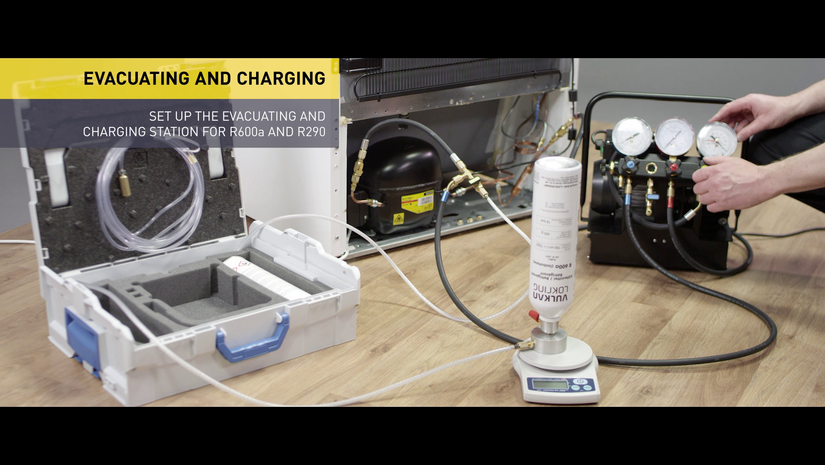
Maintenance on systems with flammable refrigerants should only be performed by trained, experienced personnel. Key precautions include: removing all ignition sources, ensuring proper ventilation, using leak detection equipment, wearing personal protective equipment, and opening cooling systems with a pipe cutter (not a saw). Disposal should be controlled outdoors, not through recycling cartridges.

How does Secop contribute to the development of hydrocarbon technology?

Secop has been committed to hydrocarbons as refrigerants since 1993 and has been developing highly efficient compressors for R600a and R290 for over 25 years. The company continuously offers new models with higher efficiency for various applications, including variable-speed compressors that save up to 40% energy and specialized solutions for extreme temperatures and medical applications.

What role do hydrocarbons play in complying with the F-Gas Regulation?

EU F-Gas Regulation 517/2014 mandates the gradual phase-out of high-GWP refrigerants. Hydrocarbons like R600a and R290 have very low GWP and are therefore an ideal long-term solution for compliance. They provide an environmentally friendly alternative to R134a and R404A, especially for low/medium back pressure (LBP/MBP) applications.

How do I find the right Secop compressor for my hydrocarbon application?

Secop offers several digital tools to assist: the Secop Toolkit app helps calculate capillary tubes for R290, R600a, and R170. The Application Selector supports choosing the most suitable compressor for specific applications and operating conditions. For customized solutions, Secop recommends contacting the specialist team directly to find the optimal solution for your specific cooling application.

我们使用 Cookie 来个性化内容和广告、提供社交媒体功能以及分析流量。我们还与我们的社交媒体、广告和分析合作伙伴共享有关您使用我们网站的信息。如果您想进一步了解我们的 cookie 并调整您的偏好,请单击 “管理偏好”。点击 “全部接受”,即表示您同意使用我们隐私政策中描述的所有 cookie。 隐私政策