Secop environmental friendly hermetic refrigeration compressors

Refrigerantes Hidrocarburos.

Los hidrocarburos se han convertido en una solución natural y sostenible preferida, y ya están presentes en una variedad de aplicaciones domésticas, comerciales ligeras, de aire acondicionado, bombas de calor e incluso en el sector médico.
Requieren solo inversiones mínimas en componentes y modificaciones de diseño, lo cual los hace ideales para su uso en sistemas de refrigeración convencionales originalmente diseñados para HFCs.

Resumen de temas:

Isobutano (R600a) y Propano (R290)

En términos químicos, un hidrocarburo (HC) es un compuesto elemental formado por hidrógeno y carbono, que se encuentra de forma natural en el ambiente en el petróleo crudo, gas natural o carbón. Es una alternativa no tóxica y respetuosa con el medio ambiente frente a los refrigerantes fluorocarbonados (CFC/HCFC/HFC), los cuales son perjudiciales para el medio ambiente debido a su vinculación con el daño a la capa de ozono y el efecto invernadero. Además de sus beneficios ambientales, los hidrocarburos son más económicos que los refrigerantes sintéticos, ya que se producen como subproductos del gas y el petróleo. Los HCs operan a temperaturas similares a los HFCs, pero requieren una menor carga de refrigerante. Sus buenas propiedades termodinámicas y físicas los convierten en una solución energéticamente eficiente.

Bajo potencial de calentamiento global (GWP)

Los hidrocarburos tienen un bajo GWP, cero ODP y, de acuerdo con la norma de seguridad ASHRAE 34, se clasifican en el grupo A3 – altamente inflamables pero con baja toxicidad. Dado que son inflamables y pueden tener consecuencias en caso de accidente, se deben considerar las precauciones de seguridad establecidas en diversas normativas internacionales y nacionales durante el diseño, ensamblaje, operación y mantenimiento de los sistemas.

Isobutano (R600a): Se utiliza ampliamente en aplicaciones pequeñas como refrigeradores domésticos, congeladores, minibares, electrodomésticos para automóviles y equipos marítimos. Propano (R290): Es común en sistemas de refrigeración comercial para servicios de alimentos y ventas al por menor, vitrinas, bombas de calor, aire acondicionado y aplicaciones médicas.


Posición de Secop sobre los Refrigerantes | Guía de Aplicación para R600a y R290

Para más detalles técnicos y operativos, consulta la Guía de Aplicación de Secop sobre R600a y R290.

Información general

Common Questions About Hydrocarbon Refrigerants

What are hydrocarbon refrigerants and why are they sustainable?

Hydrocarbon refrigerants such as R600a (isobutane) and R290 (propane) are natural compounds made of hydrogen and carbon that occur in nature. They have zero ozone depletion potential and a very low global warming potential (GWP). Compared to synthetic refrigerants like HFCs, they protect the ozone layer and contribute significantly less to the greenhouse effect. Secop has been developing highly efficient compressors for these environmentally friendly refrigerants for over 25 years.

What applications are R600a and R290 suitable for?

R600a (isobutane) is mainly used in applications with demand of low cooling capacity: household refrigerators, freezers, minibars, mobile cooling units for automotive and marine use. R290 (propane) is suitable for commercial cooling applications such as catering, food retail, merchandisers, heat pumps, air conditioning, and medical refrigeration equipment.

What are the advantages of hydrocarbon refrigerants compared to synthetic alternatives?

Hydrocarbons offer several advantages: they require 40–50% less refrigerant charge than other refrigerants, are more cost-effective than synthetic alternatives, enable higher energy efficiency and thus lower operating costs. They are also compatible with many existing system components, requiring only minimal investment in component or design changes for conventional cooling systems.

Are hydrocarbon refrigerants dangerous because they are flammable?

Hydrocarbons are classified as A3 by ASHRAE 34 (slightly flammable with low toxicity). When handled, used, and stored correctly, the risk of fire is low. Refrigerant charges are limited, and strict safety standards apply for design, installation, operation, and maintenance. Modern systems feature hermetic seals and safety measures that minimize risks

What safety standards and regulations apply to flammable refrigerants?

International and national standards have been developed for the use of flammable refrigerants, including ASHRAE 34, ISO 817, the EU Directive 2014/34/EU (ATEX), and the German Industrial Safety Ordinance. These standards specify charge limits, safety measures, electrical requirements, and maintenance regulations. For example, the latest revision of IEC 60335-2-89 increased the allowable charge for A3 refrigerants from 150 g to 500 g per circuit.

Can I retrofit an existing system with R134a or R404A to R600a or R290?

No. Retrofitting existing CFC or HFC systems to R600a or R290 is not allowed. These systems are not approved for operation with flammable refrigerants, and electrical safety has not been tested according to standards for flammable refrigerants. Hydrocarbons may only be used in new systems specifically designed for them.

What should be considered when maintaining or servicing equipment with R600a or R290?

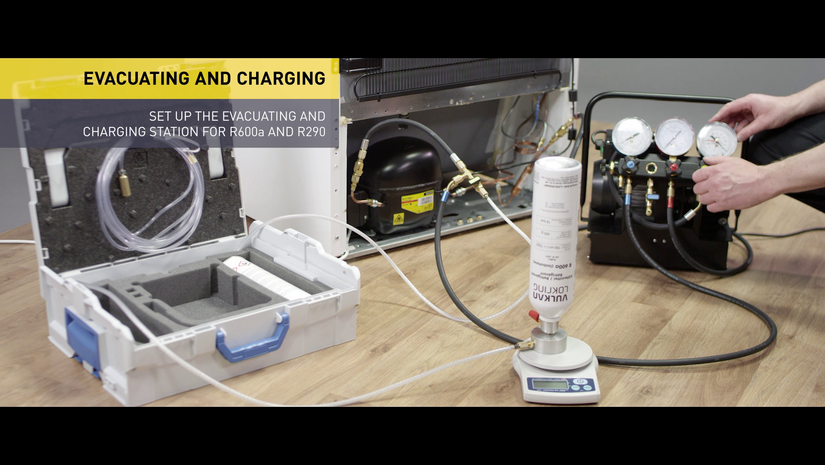
Maintenance on systems with flammable refrigerants should only be performed by trained, experienced personnel. Key precautions include: removing all ignition sources, ensuring proper ventilation, using leak detection equipment, wearing personal protective equipment, and opening cooling systems with a pipe cutter (not a saw). Disposal should be controlled outdoors, not through recycling cartridges.

How does Secop contribute to the development of hydrocarbon technology?

Secop has been committed to hydrocarbons as refrigerants since 1993 and has been developing highly efficient compressors for R600a and R290 for over 25 years. The company continuously offers new models with higher efficiency for various applications, including variable-speed compressors that save up to 40% energy and specialized solutions for extreme temperatures and medical applications.

What role do hydrocarbons play in complying with the F-Gas Regulation?

EU F-Gas Regulation 517/2014 mandates the gradual phase-out of high-GWP refrigerants. Hydrocarbons like R600a and R290 have very low GWP and are therefore an ideal long-term solution for compliance. They provide an environmentally friendly alternative to R134a and R404A, especially for low/medium back pressure (LBP/MBP) applications.

How do I find the right Secop compressor for my hydrocarbon application?

Secop offers several digital tools to assist: the Secop Toolkit app helps calculate capillary tubes for R290, R600a, and R170. The Application Selector supports choosing the most suitable compressor for specific applications and operating conditions. For customized solutions, Secop recommends contacting the specialist team directly to find the optimal solution for your specific cooling application.

We use cookies to personalize content and ads, to provide social media features and to analyze our traffic. We also share information about your use of our site with our social media, advertising and analytics partners. Click "Manage preferences" if you would like to read more about our cookies and adjust your preferences. By clicking "Accept all", you agree to the use of all cookies as described in our Privacy Policy. Política de privacidad